


It was a terribly frustrating experience, as if you came into the kingdom of heaven and you saw how it all was and you felt these new states of awareness, and then you got cast out again, and after two or three hundred times of this, began to feel an extraordinary kind of depression set in—a very gentle depression that whatever I knew still wasn’t enough.
— Ram Dass, Be Here Now (1971)
Before he was Ram Dass, he was Richard Alpert. A Harvard psychology professor with four appointments, a Mercedes, a sailboat, and every credential his world offered. But none of it filled the emptiness he carried inside. In the early 1960s, he and Timothy Leary began experimenting with psychedelics, and something stirred inside him. He glimpsed states of consciousness so vast that his old life looked like a waiting room. However, every time, no matter how high he went, he came down. Hundreds of experiences, each one a door flung open and shut again. He called it a gentle depression. The knowledge stayed, but the experience wouldn’t.
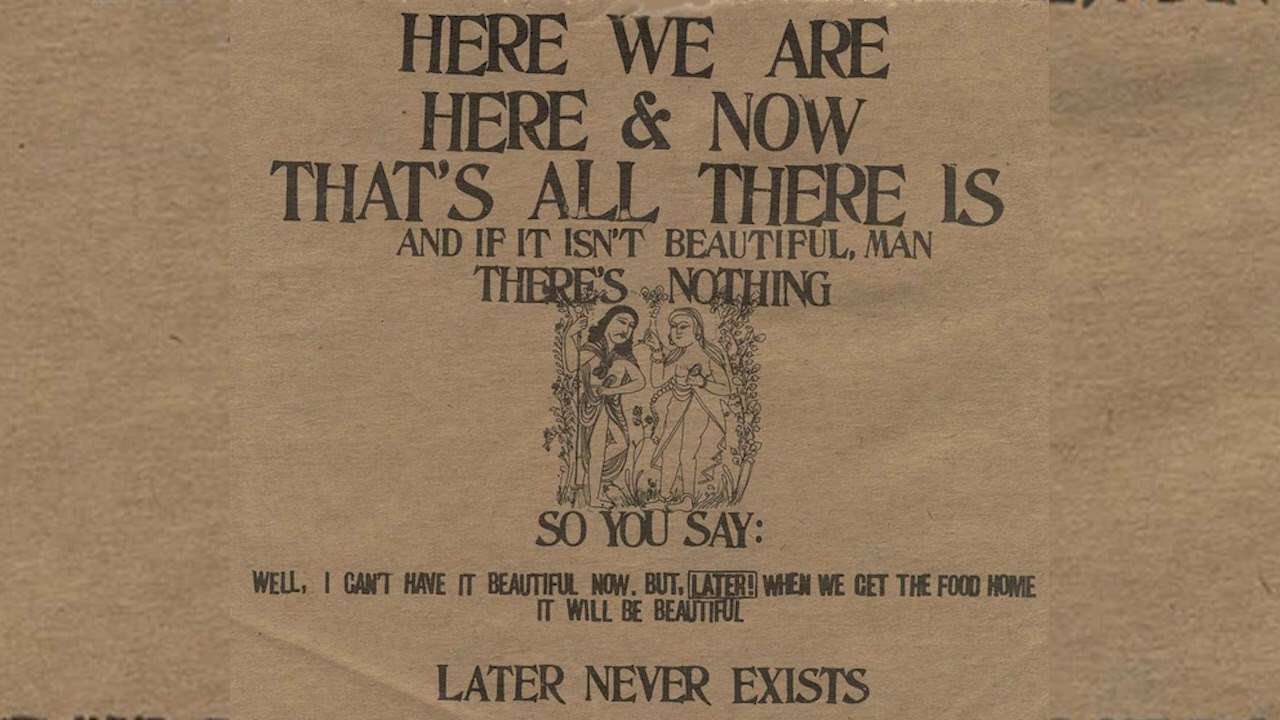
Everything changed when he met his teacher in the Himalayan foothills. His guru didn’t offer peak experiences or fireworks. He offered presence. Steady, unremarkable, and completely alive. The teaching Ram Dass carried home and put at the centre of Be Here Now is simple. Where are you? Here. What time is it? Now. He suggests setting reminders throughout the day to ask ourselves these two questions, and each time, feeling the immediacy of the answer. Wherever we go, whatever the clock says, it is always here and now. We cannot actually leave the present. We can only think our way out of it.
The mind, Ram Dass writes, is like a lake whose surface is covered with choppy waves going in all directions. We cannot see what lies beneath because we are too busy generating thought after thought, reaction after reaction. Mantra, meditation, conscious attention are not ways of forcing the waves to stop. They are ways of ceasing to believe we are the surface. Beneath the chop, awareness is already calm. Already whole. We don’t create it. We uncover it.
His teacher Hari Dass Baba put the pace of this uncovering plainly. You can’t rip the skin from the snake. The snake sheds when it is ready. We wake up at the rate we wake up. We finish with our old patterns at the rate we finish with them.
Ram Dass learned that transformation doesn’t arrive as a permanent lightning bolt. It arrives as practice. Unglamorous, unremarkable, repeated. He writes about returning from a peak experience only to hear someone say “Hey Sam, empty the garbage” — and suddenly the old identity snaps back. Just Sam who empties garbage. But eventually the understanding arrives that the sacred isn’t somewhere else. It’s in the garbage, too. Every act consecrated not by ritual but by attention. The teaching isn’t that daily life is something to endure between breakthroughs. Daily life, lived consciously, is the breakthrough.
Where have I been leaving the present in search of something better?
What would it look like to treat an ordinary act today as the practice itself?
What am I uncovering when I stop trying to force my own transformation?
How can I show up fully today without needing it to feel like a breakthrough?