

Plants and animals don’t fight the winter; they don’t pretend it’s not happening and attempt to carry on living the same lives that they lived in the summer. They prepare. They adapt. They perform extraordinary acts of metamorphosis to get them through. Winter is a time of withdrawing from the world, maximising scant resources, carrying out acts of brutal efficiency and vanishing from sight; but that’s where the transformation occurs. Winter is not the death of the life cycle, but its crucible. — Katherine May, Wintering: The Power of Rest and Retreat in Difficult Times (2020)
Katherine May wrote Wintering after the structure of her life gave way. Her husband nearly died from a burst appendix. Her son, overwhelmed by anxiety, withdrew from school. Her own body failed. The narrative she had been living inside—progress, stability, forward motion—collapsed. The book begins not with recovery or insight, but with a question. How do we live when momentum is no longer available?
Wintering is what happens when effort stops working. It arrives through illness, grief, burnout, humiliation, failure, loss. Sometimes it strikes suddenly. Sometimes it accumulates—the drip-drip-drip of eroded confidence. However it arrives, our reflex is denial. We push harder. We maintain appearances. We tell ourselves that if we can just keep going, the season will pass without costing us anything. We treat winter as a personal malfunction rather than a predictable phase of being human. We hide it. We moralize it. We turn an ordinary cycle into a source of shame.
But look at nature. Dormice build nests of grass and leaves, then drop their body temperature and sleep for months, barely breathing. Bees cluster together in the hive, vibrating their wings to generate heat, rotating who stays on the cold outer edge so no single bee bears too much. Trees shed their leaves—not from weakness, but to conserve energy, to stop losing water through surfaces they cannot sustain. No creature insists on continuity when conditions make it impossible. Winter, in nature, is not chaos or failure. It is a season with its own logic. Survival depends on adaptation, not effort.
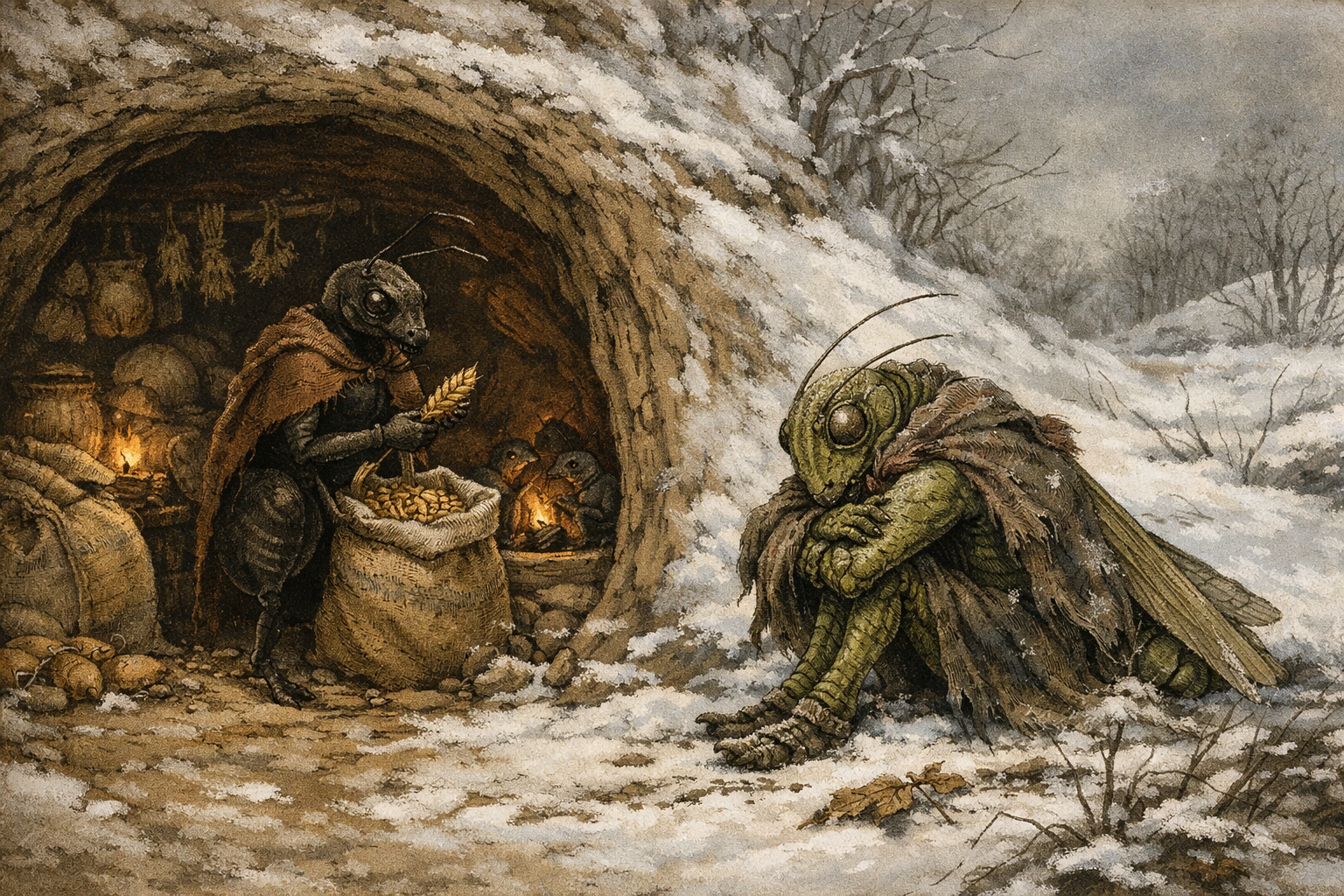
May keeps returning to Aesop’s fable of the ant and the grasshopper. The industrious ant stores food all summer while the grasshopper sings, and when winter comes, the ant refuses to share. The grasshopper starves. The moral is supposed to be about hard work and consequences. But the ant is mean and sanctimonious. The deeper cruelty is the belief that those who struggle deserve their fate. Real lives do not divide neatly into virtue and failure. We all have ant years and grasshopper years. Years when we can prepare and save, and years when simply staying afloat consumes everything. Our true flaw is not failing to store enough. It is believing that each grasshopper year is an anomaly, visited only on us, due to our unique human failings.
Winter is not a detour from life. It is not a pause between meaningful chapters. It is a season with its own requirements and its own dignity—and we are not meant to endure it alone. The people who matter most are not those who push us to get better, but those who stay without demanding change. Communities are not held together by the strong. They are held together by their capacity to care for those who cannot function for a time. Our winters are what bind us together.
What season am I in right now, and how am I responding to it?
Where have I been treating my own winter as a failure of character?
What would it mean to stop forcing momentum and instead adapt to the conditions I’m actually living in?
Who can I allow close enough to help me endure this season without turning it into shame?